PROCUREMENT · RESCUE EQUIPMENT
Rescue tripod inspection records: a buyer’s checklist
The short answer
Before requesting inspection or maintenance, list each tripod, winch and accessory by model and identifier. Gather the instructions, previous reports and known service history. Ask the provider to confirm the work it can perform, the competence required, the documents it will return and any exclusions. Keep the result linked to the equipment record. Record manufacture, purchase and first-use dates separately, and obtain any lifetime limit from the exact model instructions.
Buying a rescue system and arranging its later care are different purchasing tasks. An enquiry that only says “annual service for one tripod” may leave the winch, accessories, repair approval and report scope unclear. This guide helps procurement teams organise those questions without attempting to inspect, repair or approve equipment themselves.
1. Define the work you are asking for
List the components in scope and describe the request in plain language: an inspection proposal, planned maintenance, assessment of a reported problem, or a quotation for repair. Ask the provider to state exactly what its offer includes. Do not assume a label such as “service” includes all four.
HSE’s UK maintenance guidance emphasises competence and the manufacturer’s maintenance instructions. Use that as a prompt to ask about relevant experience and documentation, not as evidence of a provider’s credentials or a rule for every GCC site.
- Ask whether the tripod, winch and accessories are included as separate identified items.
- Request written confirmation of any manufacturer authorisation needed for the proposed work.
- Separate inspection/report fees, proposed repairs, transport and any optional work. Require approval of additional work in the quotation.
Sources: HSE: maintenance competence and manufacturer instructions (UK reference)
2. Build a record that identifies the actual equipment
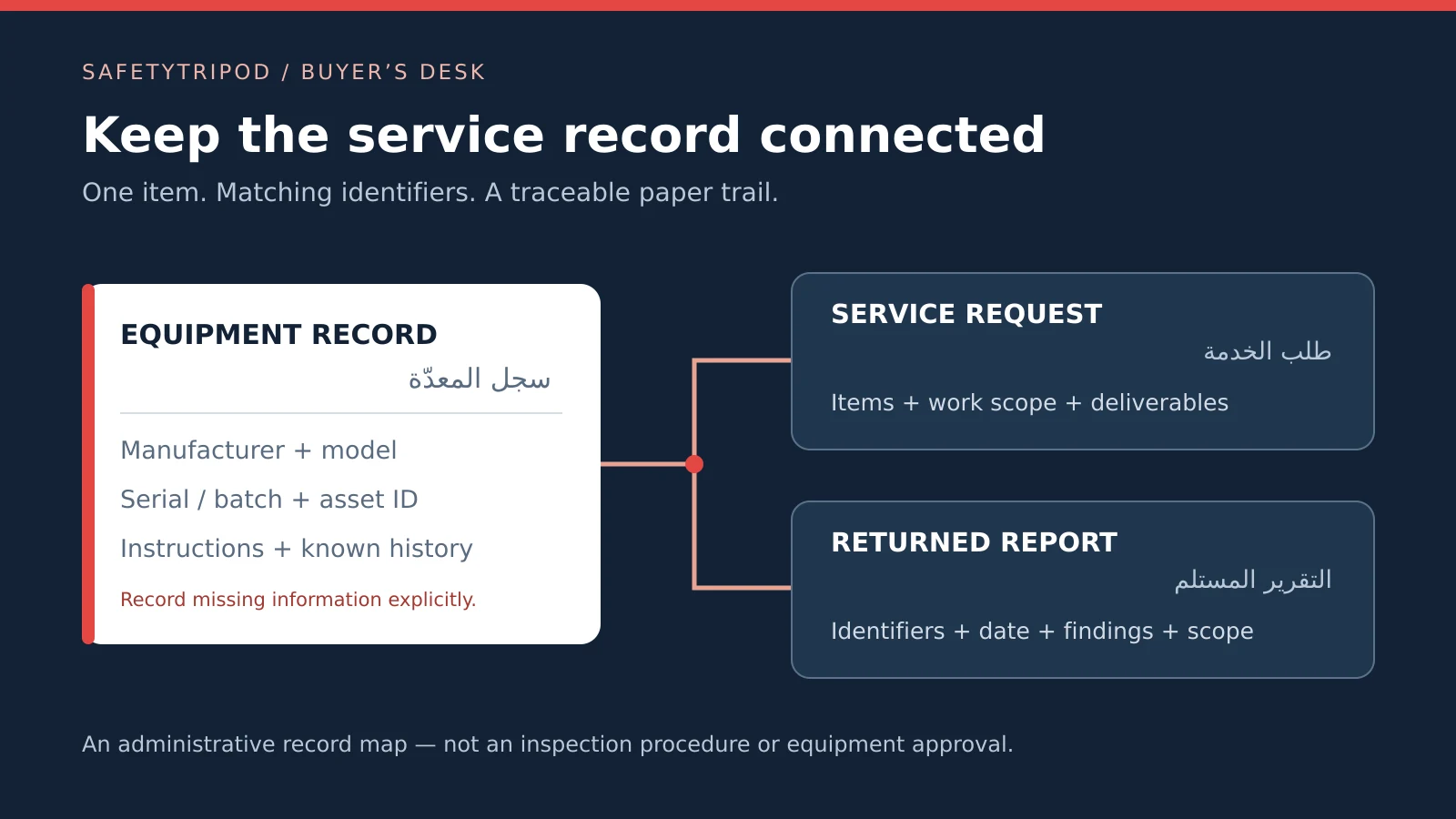
Petzl describes inspection forms linked to individual PPE through serial numbers, with batch tracking where appropriate. This illustrates traceability in its own product documentation; it does not supply a PST-361 inspection procedure.
For your enquiry, use the fields below as an administrative starting point. Leave unknown details marked “not available” and ask your responsible equipment reviewer how to resolve them. Do not replace an unreadable manufacturer identifier with a guessed number.
| Record field | Information to gather |
|---|---|
| Equipment identity | Manufacturer, model, variant, serial or batch identifier where present, and your existing asset reference. |
| Components included | Tripod, winch, brackets and other items being submitted, with a separate identifier for each where available. |
| Documents and history | Instruction title/revision, previous report references, known repairs and recorded changes of location or use. |
| Reason for enquiry | Planned review, missing record, reported issue or other concern; identify the information still unconfirmed. |
| Ownership and contact | Responsible team, equipment location and the person who will review the proposal and returned documents. |
Sources: Petzl: maintaining PPE and individual inspection records (Petzl reference)
3. Keep equipment dates and lifetime limits separate
An inspection due date and a maximum product lifetime answer different questions. The 3M tripod inspection sheet has separate fields for manufacture, first use and inspection. Its form illustrates record separation for 3M equipment; it is not a PST-361 inspection form or an acceptance decision.
Petzl’s lifetime guidance distinguishes its product categories and warns that an exceptional event can require early retirement. Where a manufacturer measures a lifetime from manufacture, buying or first using the item later does not restart that period. Do not transfer another brand’s lifetime policy to the tripod, winch or accessories in your kit.
Use this administrative table for each identified component. Keep the source of each date and the instruction revision together. If a date or rule is unknown, mark the gap and ask the manufacturer and responsible equipment reviewer to resolve it; a recent invoice or service tag is not a substitute.
| Record separately | Evidence to retain | Question to resolve |
|---|---|---|
| Manufacture date | The equipment marking or manufacturer confirmation tied to the model and identifier. | Is the date confirmed for this actual item rather than inferred from its purchase date? |
| Purchase or receipt date | The invoice or delivery record linked to the item received. | Does the paperwork identify the same component, including any substitution? |
| First-use date | The existing issue or commissioning record, where available. | Is the date documented? Keep an unknown date explicit rather than replacing it with today’s date. |
| Inspection and next review | The dated report, scope, findings and basis for any next review date. | Does the report cover this item, and are any status questions still unresolved? |
| Lifetime or retirement rule | The exact model instruction, revision and any applicable limit or event-based retirement conditions. | What starts the period, if one is specified? Who will review the record and any change in condition or history? |
Sources: 3M tripod inspection sheet: separate manufacture, first-use and inspection dates (reference products only)Petzl: equipment lifetime and early retirement (Petzl products only)
4. Ask what determines the inspection interval
HSE’s UK guidance relates inspection frequency to risk assessment, manufacturer recommendations, use and environmental conditions. It does not justify a universal annual interval for all rescue equipment. Ask your responsible team to identify the applicable instructions, site requirements and local rules.
In the proposal, request the basis for the recommended schedule and clarify who will keep it under review. A calendar reminder does not resolve a missing history, a reported problem or an unresolved equipment status. Refer those issues to the responsible safety team and manufacturer or competent service provider.
5. Agree what the returned report will contain
Before placing the service order, ask for a blank report format or a description of the deliverables. Request a report that can be matched to each submitted item, rather than an unitemised statement for a whole kit. The following are purchasing questions, not technical inspection criteria.
- Which equipment identifiers and instruction references will appear?
- Will the report state the work performed, its scope and any exclusions?
- How will findings, unresolved items, repair recommendations and any stated equipment status be recorded?
- Who performed the work, on what date, and who can answer questions about the report?
- Where a further review date is given, will its basis and any conditions be explained?
6. Close the paperwork without guessing the equipment status
Match returned items to the agreed inventory and report. Record missing pages, identifier differences and unapproved substitutions for resolution. Keep the report, repair approval and supplier correspondence linked to the same asset record.
An invoice, service tag and product conformity declaration serve different purposes. Ask the provider what any “certificate” actually documents. Send the technical findings and unresolved status questions to your responsible reviewer; purchasing paperwork alone does not authorise equipment use.
Sources: Product conformity document checklist / قائمة وثائق المطابقة
7. A service enquiry you can adapt
Please review service options for [manufacturer/model and asset list] at [country, city and site]. We can provide [instructions, previous reports and known history]. The request is [inspection proposal / maintenance / assessment of a reported issue]. Please confirm the components covered, relevant competence or authorisation, exclusions, report contents, repair approval process, transport arrangements, price and estimated timing. Identify any missing information before confirming the work.
For a PST-361 enquiry, use the listed product details to identify the model and send the actual component information through the contact page. Availability, scope and timing must be confirmed in the provider’s written response.
The PST-361 catalogue does not establish a verified lifetime or retirement date. Request the current instructions for each offered component and record that document gap explicitly before asking the responsible team to assess it.
Sources: Inspection and maintenance enquiries / استفسارات الفحص والصيانةPST-361 listed product information
Buyer questions
Is annual inspection automatically the right schedule for every tripod?
Do not adopt an interval from a general sales page. Ask the responsible team to confirm the schedule for the actual equipment using its instructions, relevant requirements and operating context. This guide does not set a PST-361 inspection interval.
Does an inspection report replace the product’s conformity documents?
Keep them as separate records. Ask what the service report covers and retain the model-specific conformity evidence supporting the original product claims. A service report should not be assumed to certify a new capacity or different configuration.
What should I do if the previous service history is missing?
State the gap explicitly in the enquiry and refer it to the responsible equipment reviewer. Ask the manufacturer or competent provider what information and assessment are needed. Do not reconstruct a history or infer acceptance from an old tag.
Does a new inspection report restart the equipment lifetime?
Do not treat the report date as a new manufacture or first-use date. Keep any model-specific lifetime limit and its starting point separate from the inspection schedule. Ask the manufacturer and responsible reviewer to resolve the applicable rule; this guide does not extend equipment life.
Does unused equipment automatically have its full lifetime remaining?
No. An unused description alone does not establish remaining life or suitability. Request the manufacture date, documented storage history and exact model instructions. If a stated lifetime begins at manufacture, later purchase or first use does not reset it. Refer missing information to the responsible reviewer.
Sources and editorial approach
- HSE: inspection of work equipment (UK reference)
- Petzl: maintaining PPE and individual inspection records (Petzl reference)
- HSE: maintenance competence and manufacturer instructions (UK reference)
- Inspection and maintenance enquiries / استفسارات الفحص والصيانة
- Product conformity document checklist / قائمة وثائق المطابقة
- PST-361 listed product information
- 3M tripod inspection sheet: separate manufacture, first-use and inspection dates (reference products only)
- Petzl: equipment lifetime and early retirement (Petzl products only)
Prepared with AI assistance using the sources listed. This is a purchasing guide, not rescue training. Other manufacturers’ references do not certify the PST-361.
Editorial policy and corrections