PROCUREMENT · RESCUE EQUIPMENT
Rescue tripod quotation checklist for GCC buyers
The short answer
For a useful rescue tripod quote, send the opening dimensions, site location, required configuration, quantity and delivery date. Ask the supplier to identify every component, provide the current model instructions and confirm compatibility, documented limits and commercial terms. A tripod load figure alone does not establish the suitability of a complete rescue system. At delivery, compare the actual component identifiers, contents and documents with the accepted offer and record differences for the responsible reviewer.
Two quotes can both say “tripod with winch” and still describe different packages. One may include the required brackets and documentation; another may leave them to a later discussion. This purchasing checklist helps an HSE or procurement team ask the same questions of each supplier and record the remaining uncertainties before placing an order.
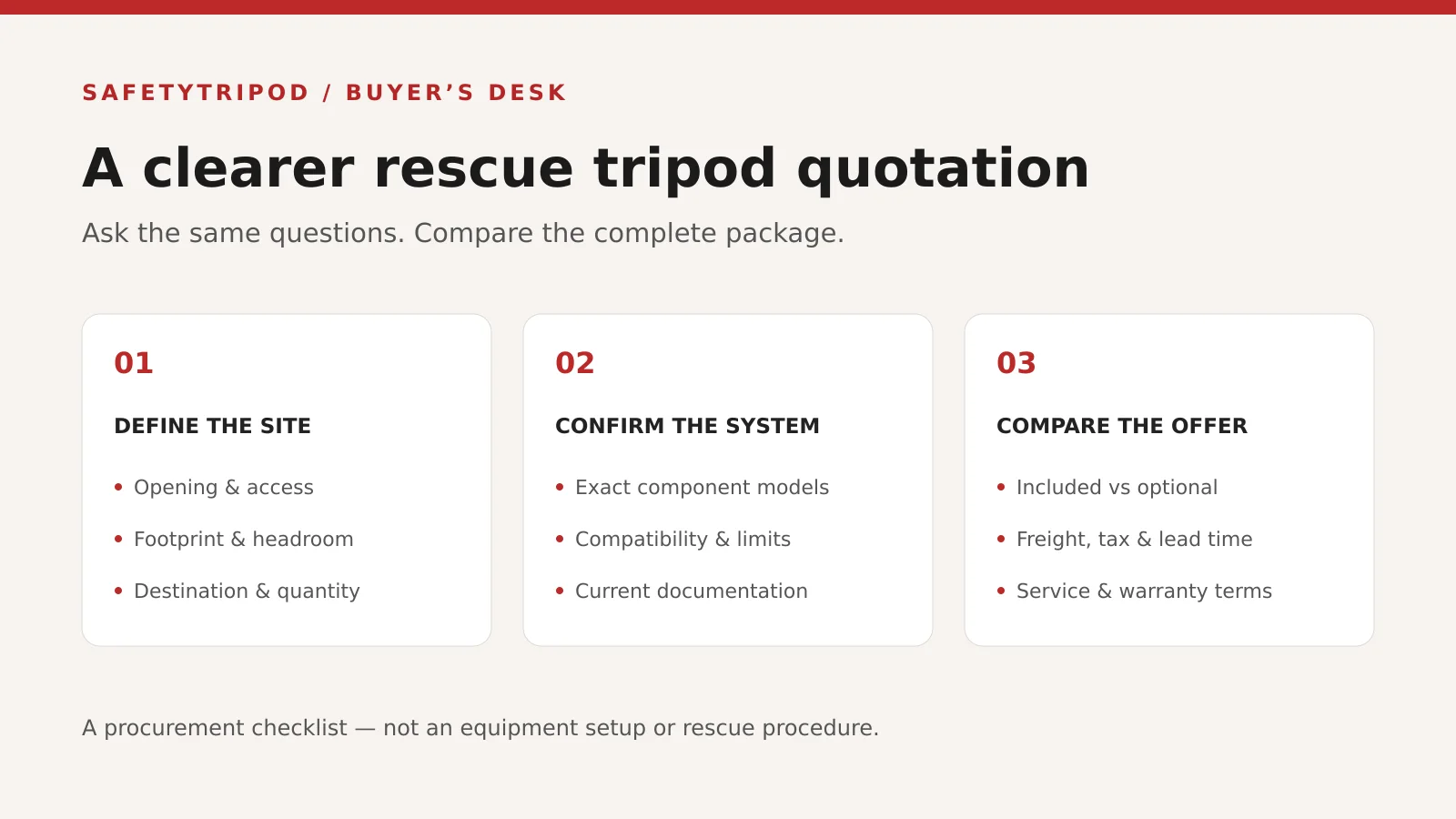
1. Describe the site before choosing a kit
Write down the delivery country and city, site contact, opening dimensions, available space around the opening and overhead clearance. Add photographs or a site drawing when your organisation permits sharing them. Record environmental conditions and access restrictions for the responsible team to assess.
Separate a requested delivery date from a confirmed lead time. A quote for delivery to a city depot is not necessarily a quote for delivery to a controlled industrial site. State the receiving location and any booking requirements clearly.
- Opening: shape, dimensions and access direction.
- Site: available footprint, headroom and conditions for assessment.
- Order: quantity, delivery destination and requested date.
- Review: name the person or team responsible for technical acceptance.
2. Ask for a complete component list
Request the exact tripod, winch, mounting bracket, line and connecting equipment proposed. Ask the supplier to distinguish included items from optional accessories. Record model numbers rather than relying on a general kit name.
The 3M reference instructions emphasise compatible components and model-specific instructions. They are useful evidence of why a system check matters; they are not certification or operating instructions for the PST-361. Obtain the documents for the actual offered equipment.
Ask which requested function is supported, not just which winch is included. The 3M Salalift/Salalift II instructions separate application types and system requirements; the Sealed-Blok range includes retrieval on selected self-retracting lifeline models. These examples show why the exact variant and instructions matter. Neither reference establishes PST-361 capability.
Use the function questions below in the supplier response. Your responsible team should identify the required tasks and review the evidence before selecting the configuration.
| Function named in the request | Evidence to ask for |
|---|---|
| Personnel raising or lowering | The exact model, permitted application and documented limits for the complete proposed configuration. |
| Material handling | The relevant load/application documentation; do not carry a material-handling figure over to personnel use. |
| Fall arrest | The identified device or subsystem and instructions for that function; a general brake description is insufficient. |
| Emergency retrieval | The exact model/variant with documented retrieval capability and any application restrictions. |
Sources: 3M DBI-SALA tripod instructions: system compatibility (reference models only)3M Salalift/Salalift II: model-specific applications and system requirements (reference models only)3M Sealed-Blok: emergency retrieval on selected SRL models (reference models only)Winch functions and compatibility enquiries / وظائف الونش واستفسارات التوافق
3. Compare the same information in each quote
Use this table as a supplier response template. An unanswered field is a question to resolve, not a reason to assume the most favourable answer.
| Request | Supplier response to record | Why it matters |
|---|---|---|
| Model identification | Tripod, winch and accessory model numbers | Makes the package and documentation traceable |
| Included items | Itemised kit and separately priced extras | Avoids comparing incomplete packages |
| Documented limits | Approved use, users and limits for the offered configuration | Separates component figures from system suitability |
| Documents | Current instructions and applicable conformity documents | Gives the responsible reviewer evidence to assess |
| Service arrangements | Inspection instructions, service availability and warranty terms | Clarifies responsibilities after delivery |
| Commercial terms | Currency, tax, freight, lead time and quote validity | Makes landed cost and timing comparable |
4. Keep listed specifications separate from approval
The PST-361 page lists dimensions and separate tripod and winch figures. Treat these as catalogue information for your enquiry. Ask what each figure means, which configuration it applies to and which manufacturer document supports it. Do not substitute a force figure for a documented personnel capacity or infer a two-person rating.
The supplier response should identify any gaps explicitly. If the proposed system changes during procurement, have your responsible team review the revised components and documents before acceptance.
Sources: PST-361 listed product information
5. Match the documents to the offered equipment
Add a document-status column to your quote comparison. For each component, record the offered model, instruction revision, conformity document reference, and any mismatch still awaiting an answer. This makes unresolved evidence visible before you select an offer.
The European Commission identifies the manufacturer as responsible for the EU declaration of conformity. When a quote makes a CE claim, request that declaration for the relevant product and match the manufacturer and product identification to the offer.
- If a declaration lists a product family but the quote names a variant, ask the supplier or manufacturer to show how that variant is covered.
- If a certificate is supplied, request its referenced schedules and check the models and scope together.
- Keep the accepted document set with the purchase order; compare the delivered identifiers with it and record any substitution.
Sources: European Commission: manufacturer responsibilities and declarationsRescue tripod document checklist / قائمة مراجعة وثائق حامل الإنقاذ
6. Compare the delivery with the accepted offer
Keep the accepted quotation and purchase-order revision as the comparison baseline. Record the receipt date and what actually arrived, including partial deliveries. A delivery record and technical acceptance are separate records: receiving the package does not establish that its configuration is suitable for use.
HSE’s UK buying guide recommends obtaining written instructions and planning acceptance checks for purchasing staff. The original worksheet below applies that document-checking approach; it is not an inspection method or a statement of GCC law. HSE flags the guide’s marking guidance as under review, so this article does not use it to establish CE or UKCA rules.
If a model, accessory or document differs, record the quoted item beside the delivered item and keep the issue unresolved until the responsible reviewer records a decision. Request the exact replacement model, revised component list and applicable compatibility documents; a supplier’s description of an item as “equivalent” is not enough by itself.
- Supplier clarification template: “Against quote/order [reference and revision], we received [model or item] instead of [agreed item]. We are missing [items or document references]. Please provide the revised item list and supporting model documents for review.” Attach label photographs only when authorised.
- Retain the supplier’s response, supporting documents, reviewer’s decision and date together. Link that record to the equipment register so later inspection or service enquiries refer to the delivered configuration.
| Check against the order | Record at receipt | Leave open when unresolved |
|---|---|---|
| Order baseline | Accepted quote/order revision, receipt date, delivery-note reference and quantities received. | Record outstanding items and partial deliveries separately from the full ordered package. |
| Component identity | Manufacturer, exact model/variant and serial or batch identifier where present, for each component. | List each substitution or identifier mismatch for the responsible reviewer. Do not assume a shared load figure proves equivalence. |
| Kit contents | Delivered winch, mounting brackets, lines, connectors and other agreed accessories, matched to the itemised offer. | Identify missing or changed accessories; do not treat an omitted part as optional without confirmation. |
| Model documents | Instruction title, revision and language; relevant declaration or other evidence reference matched to the actual model. | Name missing pages, unclear variant coverage or mismatched documents and record who will obtain clarification. |
| Resolution and handover | Supplier response reference, reviewer, decision and date, linked to the equipment record. | Keep unresolved questions visible. A completed receiving checklist is not permission to operate the equipment. |
Sources: HSE: Buying new machinery — UK guide and notice that marking guidance is under review / دليل بريطاني مع تنبيه بشأن تحديث إرشادات العلاماتHSE INDG271, pages 5–6: written instructions and purchasing acceptance checks (UK reference; not marking rules) / مرجع بريطاني للوثائق ومراجعة الاستلام، وليس لقواعد العلاماتRescue tripod document checklist / قائمة مراجعة وثائق حامل الإنقاذEquipment records and unresolved document requests / سجلات المعدات وطلبات الوثائق غير المحسومة
7. Keep purchasing and rescue planning connected
A purchase order does not establish a safe entry procedure. OSHA’s US confined-space standard covers rescue arrangements as well as retrieval equipment, with conditions and exceptions. It is a reference for the scope of planning, not a statement of UAE or other GCC legal requirements.
Have the responsible site team confirm the applicable local rules, operator requirements, equipment instructions and rescue plan. This article does not provide entry or rescue training.
Sources: OSHA 29 CFR 1910.146: permit-required confined spaces (US reference)
8. A short RFQ you can adapt
Please quote a rescue tripod system for [country, city and site], quantity [number], requested delivery [date]. Our opening dimensions are [dimensions], with [available footprint and headroom]. Please identify the tripod, winch and all included accessories by model; confirm compatibility and documented limits; and list the current instructions and conformity documents supplied. Show optional items, freight, taxes, quote validity, warranty and inspection/service arrangements separately.
Attach only information you are authorised to share. Use the product and contact links below to start an enquiry, then retain the final supplier response with your purchasing records.
Buyer questions
Can I choose a rescue tripod using its load number alone?
No. Request the documented limits, approved use and compatibility of the complete configuration. Individual tripod and winch figures do not establish a personnel or two-person system rating.
What should a GCC delivery quote include?
Ask for the country and receiving location, freight and tax treatment, lead time, quote validity and any site delivery conditions. Availability and delivery dates should be confirmed in the actual offer.
Do third-party manufacturer manuals certify the PST-361?
No. Reference manuals explain why model-specific documentation matters. Request the current documents and conformity evidence for the exact PST-361 configuration being offered.
Does a winch brake mean the quoted kit provides fall arrest?
No. Ask which exact device and configuration provide the required function and request their supporting instructions. Treat a brake description, component rating and retrieval claim as separate items to verify; none establishes every function of a complete kit.
Can I accept a substitute winch with the same load number automatically?
No. Record the exact quoted and delivered models and ask for the replacement’s instructions, documented functions and mounting/system compatibility. The same load number does not establish equivalence. Refer the change and supporting documents to the responsible technical reviewer before acceptance.
What should I record if the model documents will arrive later?
Keep the delivery record separate from the technical review status. List the missing documents, the person following up and the supplier’s response reference. Leave document verification unresolved until the relevant material has been received and reviewed; a delivery note alone does not complete that review.
Sources and editorial approach
- 3M DBI-SALA tripod instructions: system compatibility (reference models only)
- OSHA 29 CFR 1910.146: permit-required confined spaces (US reference)
- PST-361 listed product information
- European Commission: manufacturer responsibilities and declarations
- Rescue tripod document checklist / قائمة مراجعة وثائق حامل الإنقاذ
- 3M Salalift/Salalift II: model-specific applications and system requirements (reference models only)
- 3M Sealed-Blok: emergency retrieval on selected SRL models (reference models only)
- Winch functions and compatibility enquiries / وظائف الونش واستفسارات التوافق
- HSE: Buying new machinery — UK guide and notice that marking guidance is under review / دليل بريطاني مع تنبيه بشأن تحديث إرشادات العلامات
- HSE INDG271, pages 5–6: written instructions and purchasing acceptance checks (UK reference; not marking rules) / مرجع بريطاني للوثائق ومراجعة الاستلام، وليس لقواعد العلامات
- Equipment records and unresolved document requests / سجلات المعدات وطلبات الوثائق غير المحسومة
Prepared with AI assistance using the sources listed. This is a purchasing guide, not rescue training. Other manufacturers’ references do not certify the PST-361.
Editorial policy and corrections